
Trying to Overcome: A Story of Challenges Breeding Compassion for Others
Experience the joys and pains of David Gabriel, an Ecuadorian German, and see how he is still able to find compassion for others despite the hardships he has faced.
STORIES
Dani Fielder
10/14/20256 min read

When asking David Gabriel what the theme of his life is and reciting back all the hardships he has faced in only twenty-eight years of life, I ask him if he believes that “overcoming” would be the overall theme of his story. Gabriel, however, counters by saying, “I would call it trying to overcome.” From dealing with the divorce of his parents, to navigating life between two very different cultures, to experiencing the early death of a close family member, he has had his fair share of life struggles and still manages to maintain his joy and compassion towards others.
Meet David Gabriel.
He is an Afro-Latino born in Mosbach, Germany, and has ethnic roots in both Ecuador, from his mother, and Germany and Austria, from his father.
Growing up in Germany, he recalls visiting his Ecuadorian family who lived in Italy, stating, “at that time, I already felt a difference between German culture and Ecuadorian culture.” Gabriel remembered, at a young age, often desiring to travel from Germany to see his family in Italy because of the food, music, and the overall cultural atmosphere. Being both Ecuadorian and German, he says that he has questioned what parts of us as humans are part of our culture and what parts of us are just personality, explaining that not all things he does because he is Ecuadorian or German, but other things he does are because that's just the way people in his cultural groups do it.
In 2005, when Gabriel was eight, his father decided to move his family, consisting of his father, his mother, his older brother, and his younger sister, from Germany to Ecuador. He explains that it was easy for him to leave Germany, but once he arrived in Ecuador, it was a huge culture shock. Moving to Ecuador, he did not speak Spanish very well, at the time, but as a child, he always felt confident enough to speak.
With a broad smile, Gabriel explains how he got into a major accident at age nine in which a bus ran over his right thigh on his way home from school one day. He describes how it was common at the time for buses, since they were privately owned and there were no bus stations, to compete for clients and to speed through the Ecuadorian streets. On this particular day, his brother picked him up, and to him it seemed like the driver was competing with other buses and possibly even drinking because there was a beer next to him. Gabriel recalls trying to get off the bus, and the bus continuing to roll off, causing him to fall in a way that his leg ended up under the tire. "Your leg should have been pulverized," Gabriel says, repeating what the doctors who saw him after the incident said in shock. Gabriel, still having a mark on his leg from the incident, considers it a miracle, especially considering the bone did not break.
During the first two to three years of living in Ecuador, his parents were together. He explains that his father had a problem with drugs and believes that his drug addiction eventually led to their separation. He states further that, "it just didn't work out because whenever we would do well, money would disappear." Although his mother wanted to help his father with his recovery, around the age of eleven or twelve, Gabriel's father had filed for a divorce. Gabriel admits that at the time, the situation made him angry to think about how his father left his family. During the divorce process, he was responsible for writing letters and corresponding with German attorneys on his mother's behalf because of his knowledge of the language. "I really felt like my time to be a kid had stopped...I basically felt like I skipped childhood, and I skipped my teenage years as well."
Returning back to Germany in March of 2012 and at the age of fifteen, he recalls a hope he had that things would be better or more stable and that he would be able to enjoy the rest of his teenage years. He was disappointed, however, when that was not the case. "I was an immigrant [in Germany] basically. People don't see me as 'here comes the German. One of us.' People 'other' me here." In Ecuador Gabriel felt more accepted, whereas in Germany, he says people definitely see a difference. "It's a guessing game where I'm from. People don't know how to feel about me cause they cannot put me in a box."
"Coming here [to Germany], I had to relearn German. It was a whole culture shock again," Gabriel says as he thought back to that time period in his life.
"All the pressure I thought I had left behind came crawling over the ocean." Although he was leading the music ministry at his church and he felt he was able to use music as an outlet, he explains, "mentally I had gone into depression and dealt with anxiety after the first thrill of moving [to Germany]." So, at eighteen, Gabriel moved out, and he expressed an interest in figuring out life on his own. At one point, he lived with his brother, and then later by himself.
One day in 2016, he got a phone call from his cousin in which she asked if he was okay. At this, he says he was confused, leading to his cousin hanging up the phone. Then another cousin called and told Gabriel that he wanted to be completely honest. This was the moment Gabriel learned that his brother had passed away. "I didn't believe it at first, so I called home and a police officer confirmed it for me."
"It turned really real, really quick, but at the same time, I had already been depressed," Gabriel says thinking back to that dreadful day. Reminiscing on the death of his brother, he says, "I was so numb. I would go lock myself in the bathroom, cry, wipe my tears, and come out."
He explains that his family never truly understood the full story of his brother's death, but that they found out that his brother somehow fell on the train tracks at the station and got stuck between a train and the platform. "For the rest of my life, it will always be a thing, you just learn how to deal with it." Recalling his family's grieving period, he was glad that even during a tragic situation, his family was able to reconnect and share that time together.
Following the time period he was able to spend with his family, he went back to live by himself in his apartment, but he admits that at this point in his life, he was spiraling downward. So, at twenty-one, Gabriel decided to go back to Ecuador to go backpacking through the country as a tribute to his brother. "It was the most healing thing I could have done, really." After spending three months traveling through Ecuador, he returned to Germany and felt better, but after a year, he said that he began to spiral again.
During this time, a man from a church located near his home invited Gabriel to come to church with him. Although Gabriel was hesitant at first, after repeatedly being asked, Gabriel began to go to the church where he met students from the European Theological Seminary, or ETS where he later decided to study.
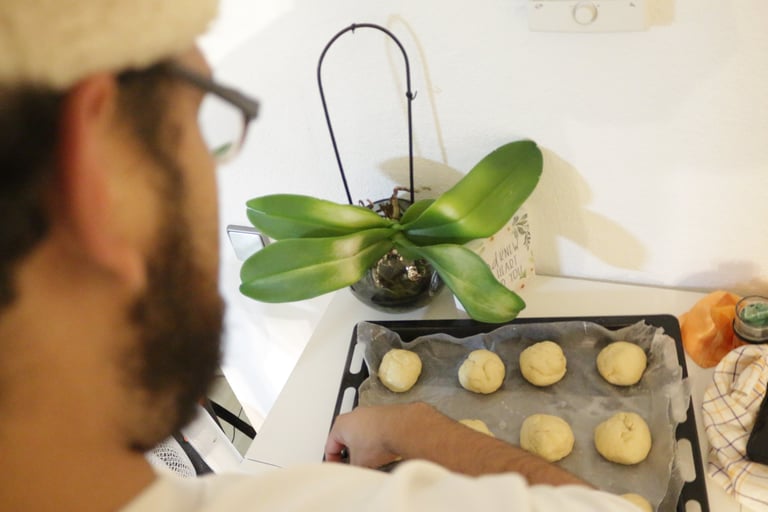
Gabriel bakes an Ecuadorian bread called Pan Mixto that he says reminds him of his childhood. (Photographed by Dani Fielder)
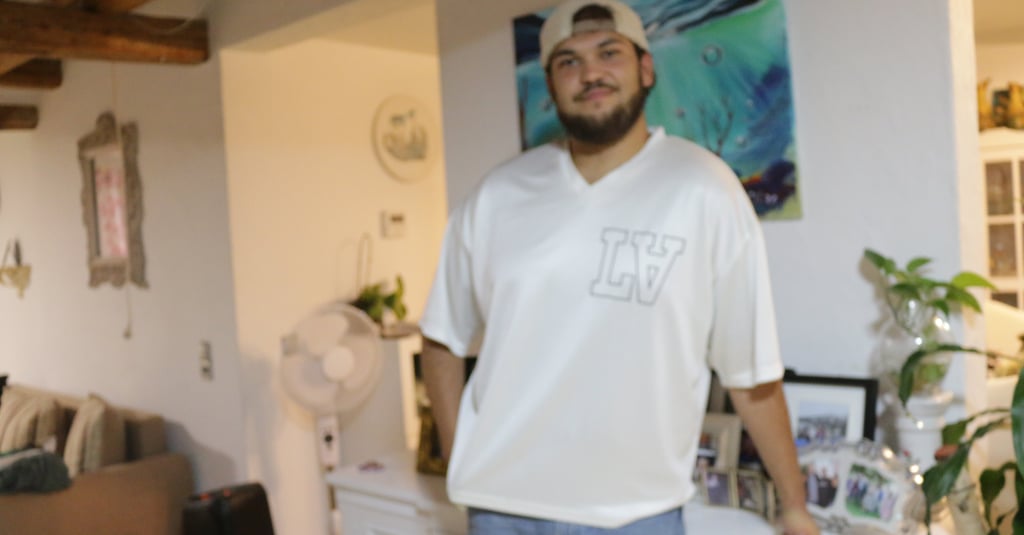
David Gabriel stands smiling in his family home in front of pictures of him and his family. (Photographed by Dani Fielder)

Thinking of all the negative things that have gotten him to this point in his life, he realizes the moments that are never going to leave him are the experiences he had with God. “Yeah, all these things happened, but it wasn’t God doing them. It was just life.” He gives God credit for all he has overcome, stating, "many things I wasn't really in control over."
"I think the biggest success (...) apart from the fact that I'm alive is that it hasn't made me bitter or cold towards the suffering of others," he explains, saying that all he has gone through only makes him feel more empathetic towards others.
Considering his future, he says, “For me, it makes sense to think of myself like someone who wants to become a cycle breaker. To let all these things go. To start fresh. To impact the rest of my family positively.”
After all he has been through, he says he can speak on many different situations or be able to relate to what people are going through. His final statement is, “don’t judge a book by its cover. You never know someone’s story, but at the same time, treat other people with respect. Respect other people’s dignity and don’t close yourself off to accepting the experience of someone else.”
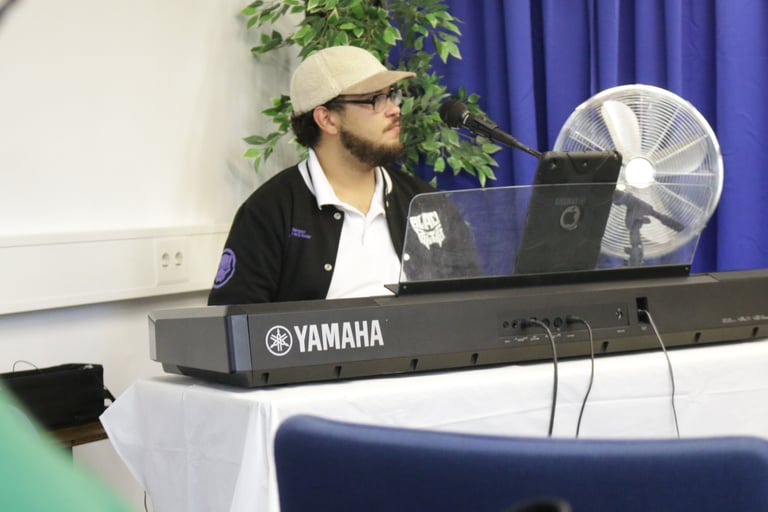
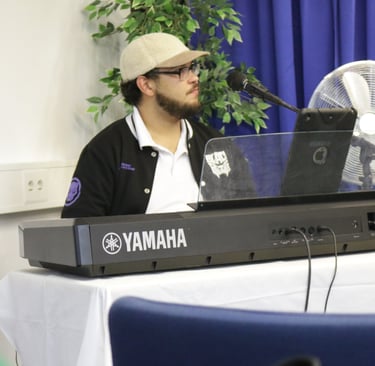
Gabriel sits intently listening to the pastor after playing the piano and singing for praise and worship time at his church, Stuttgart New Beginnings. (Photographed by Dani Fielder)
Holy Lord written and performed by David Gabriel


The Pan Mixto shines golden brown as it comes out the oven. (Photographed by David Gabriel)
Follow David Gabriel on Instagram